



A system of record for everyone who isn't an employee
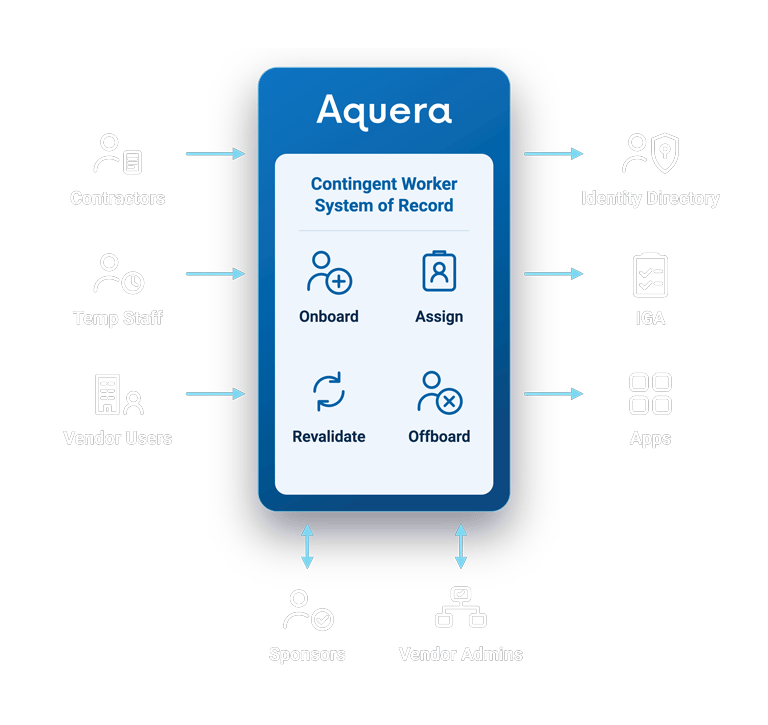
Contractors, consultants, temp staff, and vendor users aren't in your HCM system, so no system drives their lifecycle. Aquera is the system of record, governance layer, and automated lifecycle engine for every contingent worker: created, validated, sponsored, revalidated, and offboarded through a governed, auditable workflow.
Trusted by 1,500+ Organizations Worldwide




.svg)














.png)






Built for the scale identity actually runs at
They arrive, they get access, and then they're forgotten
Non-employees rarely exist in the HR system, so they get tracked in spreadsheets and provisioned once, sponsors move on, engagements end quietly, and accounts linger for weeks with no lifecycle, no owner, and no clean evidence when the auditor asks.
Contingent Worker Identity Solution Brief
Lifecycle, capabilities, integrations, and the complete comparison, learn more now.
From onboarded contractor to closed engagement
Aquera records every contractor, vendor, and partner in a dedicated system of record, keeps access current with risk scoring and scheduled revalidation, then removes it automatically when the engagement ends.
Give non-employees a real system of record
A dedicated SOR holds every contractor, vendor, and partner, with sponsor and engagement dates, so non-employees are managed like people, not spreadsheet rows.
- Dedicated SOR. An authoritative source for non-employee identity.
- Sponsor ownership. Every record has a named, accountable sponsor.
- Vendor views. Group and govern by vendor or engagement.
Reviews and revalidation that actually fire
Configurable risk scoring and scheduled revalidation keep access current, by time, event, or sponsor, with full compliance history behind every decision.
- Risk scoring. Configurable profiles and scales per population.
- Scheduled reviews. Time-, event-, or sponsor-driven revalidation.
- Compliance history. Every review and decision retained for audit.
Close the engagement, close the access
When an engagement ends, or a revalidation lapses, access is removed automatically across the directory and apps, so contractors don't linger as orphaned accounts.
- Automatic de-provision. Access removed when the engagement ends.
- Same lifecycle as staff. Onboard, maintain, and offboard end to end.
- Audit evidence. Proof the account was closed, and when.
Close the third-party access gap auditors keep flagging
A real system of record
Identity, role, sponsor, engagement dates, and risk profile, captured fully separate from the HCM, not in a tracker that goes stale.
Accountability built in
Every worker has a named internal sponsor, and vendors manage their own users within guardrails, hierarchical and fully audited.
Offboarding the system enforces
Access is revoked at engagement end, project completion, or failed revalidation, automatically, so no orphaned accounts linger.
From manual scramble to managed lifecycle
Take the proof with you
Let's get started.
A 30-minute walkthrough of the full lifecycle, create, validate, sponsor, revalidate, and offboard every contractor, vendor, and partner through one governed workflow.
Frequently asked questions
What is contingent worker identity management? +
Contingent worker identity management is the practice of creating, governing, and retiring digital identities for non-employees, contractors, consultants, temp staff, vendors, and seconded workers, who are not in the corporate HR system. Because these workers aren’t in the HCM, no system of record drives their access lifecycle. Aquera provides a purpose-built Contingent Worker Identity system of record (SOR) that automates onboarding, sponsorship, revalidation, and offboarding for every non-employee identity.
What is a non-employee system of record (SOR)? +
A non-employee system of record is an authoritative database of every contingent worker identity, capturing identity, role, named sponsor, engagement dates, risk profile, and revalidation history, maintained separately from the HR system. Aquera’s Contingent Worker SOR feeds these identities directly into the identity stack (Okta, Microsoft Entra ID, Active Directory) so access is provisioned, governed, and revoked automatically across the full engagement lifecycle.
Why can’t IGA platforms manage contingent worker identities on their own? +
IGA platforms govern identities that already exist, they assume an authoritative source (usually the HCM) has created the identity. Contingent workers aren’t in the HCM, so IGA tools have no record to govern. Aquera fills that gap: it creates and validates the identity before Day 1, acts as the source of record, and feeds the existing IGA and IDP, closing the lifecycle with automated offboarding at engagement end.
What percentage of data breaches involve third parties or contractors? +
63% of data breaches involve third parties, including contractors, according to the IBM Cost of a Data Breach Report 2023. Contractor accounts that outlive their engagements are a recurring factor in breach post-mortems, which is why automated, system-enforced offboarding for contingent workers is a core security control.
How long do orphaned contractor accounts typically stay active? +
Orphaned contractor accounts remain active an average of 47 days after termination when offboarding isn’t centralized, per the Cybersecurity & Infrastructure Security Agency (CISA). With Aquera, access is revoked across the IDP, IGA, and connected applications on the engagement end date, no ticket or manual step required.
Do companies fail compliance audits because of contractor oversight? +
Yes, 85% of organizations fail at least one compliance audit related to third-party or contractor oversight, according to the Ponemon Institute. The same findings recur every cycle: orphan accounts, missing sponsor records, and no revalidation trail. A contingent worker system of record with a complete lifecycle audit trail addresses the root cause rather than the symptoms.
What does Aquera’s contingent worker identity solution do? +
Aquera provides the system of record, governance layer, and automated lifecycle engine for every contingent worker. It creates and validates identities before Day 1, routes access requests through approval workflows, provisions to the IDP and downstream applications, revalidates on schedule or events, and automatically offboards at engagement end, with a complete, defensible audit trail and no spreadsheet tracking.
What are the core capabilities of Aquera Contingent Worker Identity? +
Aquera Contingent Worker Identity has four core capabilities. System of Record: one authoritative record per worker, identity, sponsor, engagement dates, risk profile, and full history. Sponsor Workflows: named sponsors and delegated vendor admins manage users within guardrails, hierarchical and fully audited. Auto-Revalidation: prompts by schedule, event, or lack of use, with access suspended automatically if no one responds within the window. Forced Offboarding: access revoked across the IDP, IGA, and applications at engagement end, no ticket, no manual step, no orphans.
What is forced offboarding in Aquera? +
Forced offboarding is Aquera’s system-enforced removal of contingent worker access: at engagement end, access is revoked across the IDP, IGA, and connected applications, no ticket, no manual step, no orphans. Offboarding also triggers on project completion or a failed revalidation. Because the system enforces the end date rather than waiting for a person to remember, orphaned accounts are eliminated rather than cleaned up after the fact.
What is automated revalidation? +
Automated revalidation prompts sponsors and vendor admins to re-confirm a worker’s access by schedule, by event trigger (role change, project end), or by lack of use. If no one responds within the configured window, access is suspended automatically. Unlike manual certification campaigns, revalidation is continuous and enforced by the system.
Does Aquera replace Okta, Microsoft Entra ID, or Active Directory? +
No, Aquera fits your existing identity stack rather than replacing it. Contingent worker identities are sourced directly into the identity pipeline through Okta, Microsoft Entra ID, or Active Directory, and your IGA keeps governing access with Aquera as the authoritative non-employee source of record. It deploys in weeks alongside the IDP and IGA you already own.
How is Aquera different from IGA platforms like Okta, Entra ID Governance, or Saviynt? +
IGA platforms govern identities that already exist; they don’t create contingent worker identities, have no sponsor model, and rely on manual certification campaigns. Aquera is the purpose-built system of record that starts before Day 1, creating, sponsoring, revalidating, and force-offboarding every non-employee identity, and feeds the IGA and IDP you already own. It complements the identity stack rather than replacing it.
How long does it take to deploy Aquera’s contingent worker solution? +
Weeks, not quarters. Aquera deploys with pre-built connectors to Okta, Microsoft Entra ID, Active Directory, and Saviynt, no custom engineering. By comparison, building a contingent worker SOR in-house typically takes 18+ months of integration work and breaks whenever the HCM schema changes.